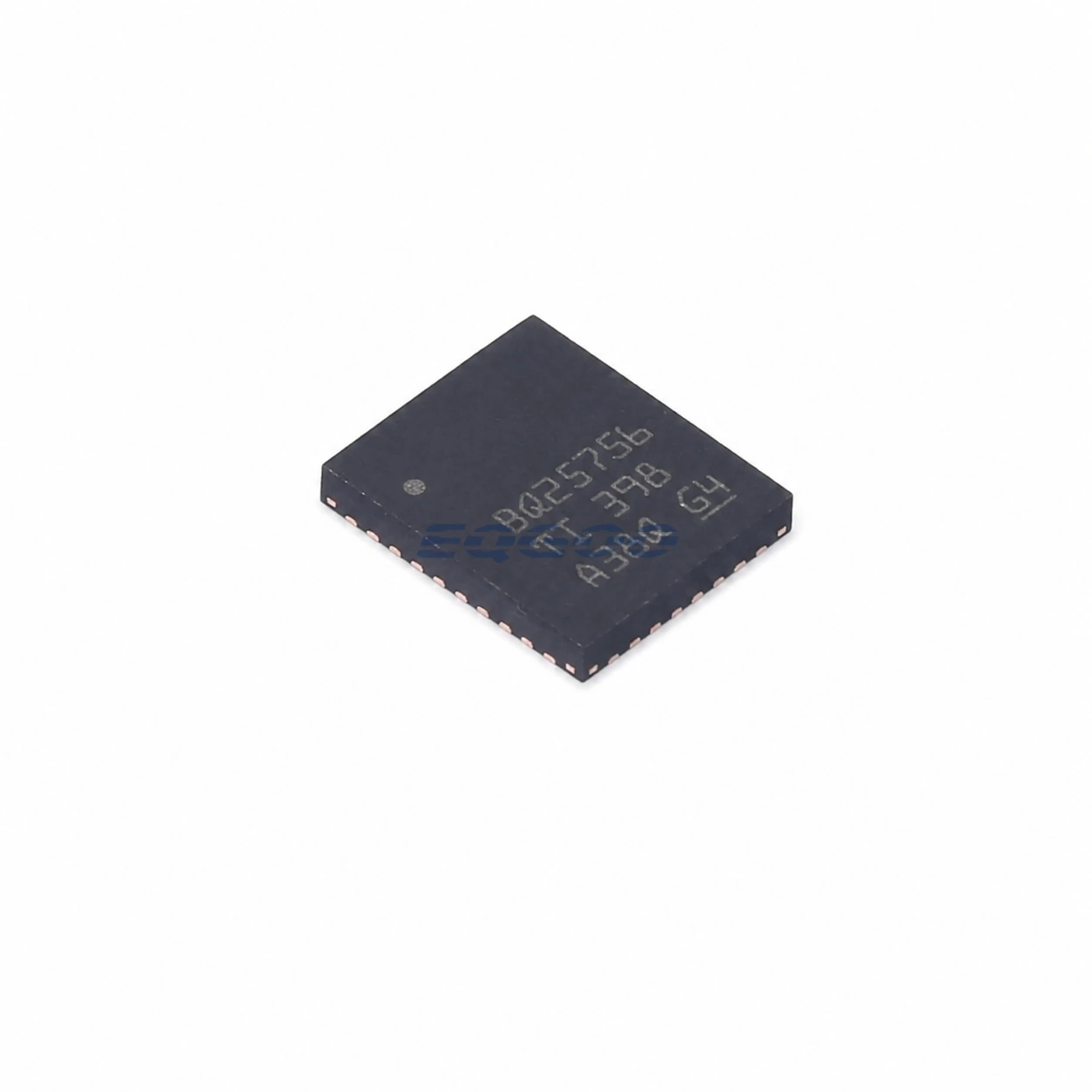

Key Selection Information
| Selection Parameter | Confirmed Information |
|---|---|
| Converter Architecture | Bidirectional synchronous buck-boost controller with external NFETs |
| Input Operating Range | 4.2 V to 70 V |
| Battery Range | Up to 70 V; 1-14S Li-Ion or 1-16S LiFePO4 profiles |
| Solar Function | Automatic MPPT with full-panel sweep and perturb-and-observe control |
| Switching Frequency | Adjustable 200 kHz to 600 kHz |
| Reverse Operation | Battery-to-input CC/CV power flow for bidirectional applications |
| Control / Monitoring | I²C plus hardware current limits and integrated 16-bit ADC |
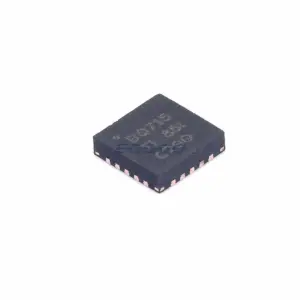
| Exact Package / Packing | VQFN (RRV), 36 pins, 6 mm × 5 mm; 3000-piece large tape and reel |
Product Overview
BQ25756RRVR is a wide-voltage bidirectional buck-boost battery-charge controller for systems that combine high-series-count batteries with solar or other variable input sources. It operates from 4.2 V to 70 V, supports battery voltage up to 70 V, and drives an external four-switch N-channel MOSFET power stage so the same converter can charge when input voltage is above or below the battery.
Its defining difference from a conventional wide-range charger is the integrated solar MPPT algorithm. With MPPT enabled, the device can momentarily enter high-impedance mode to measure panel open-circuit voltage, sweep the programmed input-voltage window, compare charge-current output at each point, store the detected maximum-power voltage, and then continue tracking. The full-panel sweep interval is programmable and can also be forced by the host.
This matters because a solar panel is not a stiff voltage source. The charger must avoid collapsing panel voltage while still extracting available power. The MPPT loop therefore changes battery charge current as source conditions change, making the panel, search window, system load connection, and current-sense scaling part of the charger design.
For related devices, see HKEQGOO’s Battery Chargers category.
Technical Specifications
| Parameter | Verified Information |
|---|---|
| Manufacturer | Texas Instruments |
| Exact MPN | BQ25756RRVR |
| Topology | Bidirectional synchronous buck-boost controller |
| Input Voltage | 4.2 V to 70 V |
| Battery Voltage | Up to 70 V |
| Li-Ion Support | 1 to 14 cells |
| LiFePO4 Support | 1 to 16 cells |
| Switching Frequency | 200 kHz to 600 kHz |
| Charge-Voltage Accuracy | ±0.5% stated feature |
| Charge-Current Accuracy | ±3% stated feature |
| Input-Current Accuracy | ±3% stated feature |
| MPPT | Full-panel sweep with programmable timing and detected MPP register |
| Reverse-Mode Input Voltage Regulation | 3.3 V to 65 V, 20 mV steps stated feature |
| Input Current Scaling | Up to 20 A with 5 mΩ RAC_SNS under TI’s stated feature conditions |
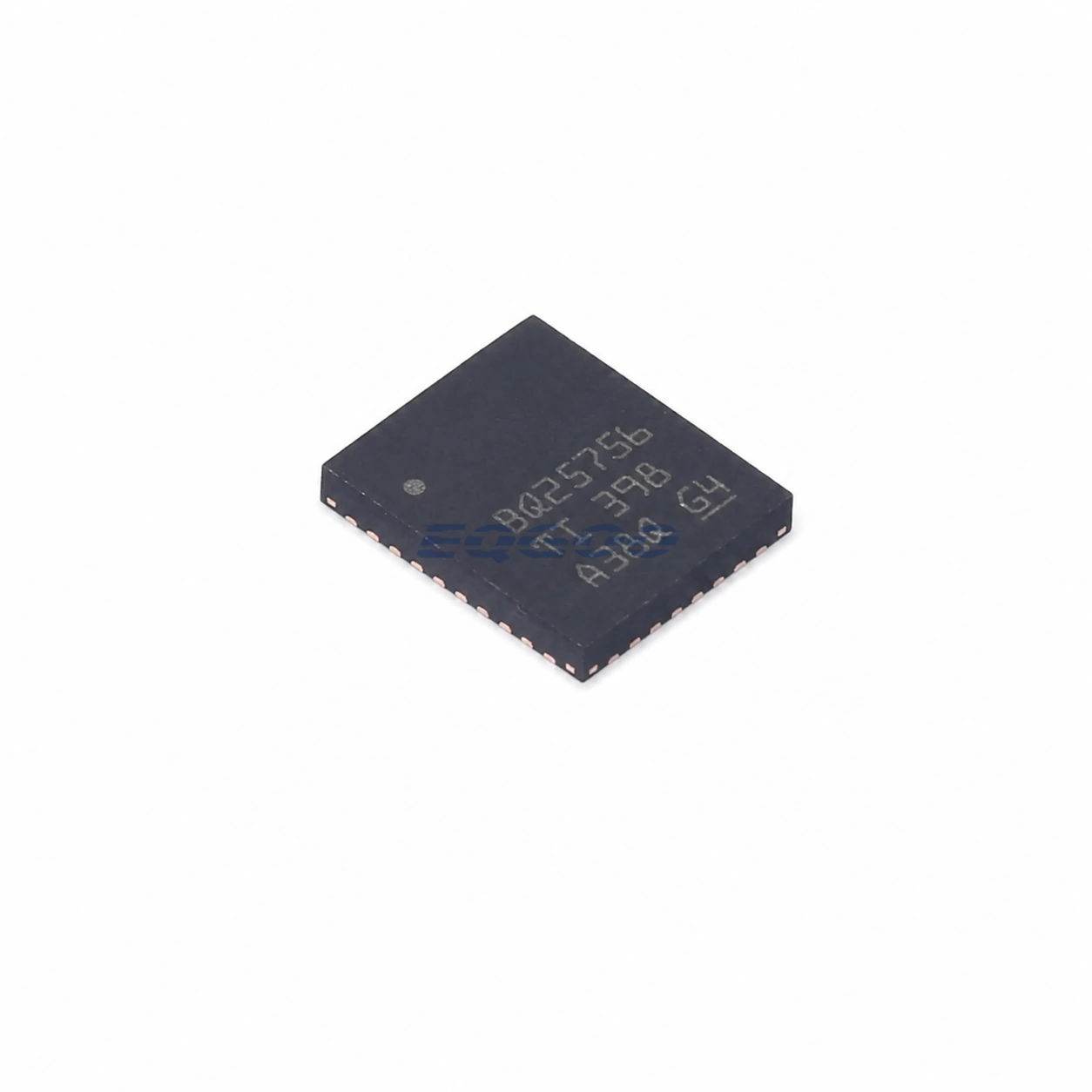
| Package | VQFN (RRV), 36 pins, 6 mm × 5 mm |
| Manufacturer Status | Active / Production |
| Part Marking | BQ25756 |
Functional Highlights
MPPT searches for the operating point instead of using only a fixed solar voltage
BQ25756 can perform a full panel sweep rather than relying only on a fixed input-voltage target. During the sweep it measures source open-circuit voltage, moves the input regulation point through the configured range, observes the resulting battery charge current, and records the voltage that produces the highest output. The sweep interval can be set to 3, 10, 15, or 20 minutes, and the device also provides perturb-and-observe timing options.
TI notes that if the system load is connected directly to the input source, the charger cannot control that load and may not find the true panel maximum-power point. For MPPT-oriented designs, system-load placement is therefore an electrical architecture choice rather than a wiring detail.
Current-sense resistance changes the usable current range
The input-current limit and monitoring scale depend on RAC_SNS. TI describes 2 mΩ as the default scaling and 5 mΩ as an option when 50 mA input-current resolution is preferred. Changing the resistor changes both the measurable/programmed current range and conduction loss, so a headline high-current value cannot be separated from the selected sense resistor.
Reverse mode reuses the same power stage in the opposite direction
With sufficient battery voltage and valid gate-drive conditions, reverse mode transfers energy from the battery toward the input side under programmed CC/CV control. Reverse voltage, input current, and battery-discharge current limits all need to be coordinated with the same MOSFET, inductor, connector, and thermal ratings used during charging.
Design Considerations
- Program the MPPT search window for the real panel. VAC_DPM and the ACUV/ACOV hardware window define where the sweep is allowed to operate.
- Place the system load consistently with the intended MPPT behavior. A load directly on the solar input can distort the relationship between charger-controlled current and actual panel power.
- Select current-sense resistors before finalizing current limits. Register resolution, maximum programmable current, measurement gain, and resistor loss depend on these values.
- Rate the four-switch external stage for buck, boost, and reverse power flow. MOSFET voltage, RDS(on), switching loss, inductor saturation, and thermal paths must all be checked in both directions.
- Do not treat 70 V operation as an automatic power level. Voltage range is a controller capability; practical power is limited by the external stage, cooling, current sensing, PCB copper, and connectors.
Product Status and Exact Order Code
Manufacturer status: Active / Production
Texas Instruments lists BQ25756RRVR in the 36-pin VQFN RRV package with a 3000-piece large tape-and-reel carrier, Level-1-260C-UNLIM MSL classification, an operating-temperature listing of −40°C to +125°C, and part marking BQ25756.
Related Engineering Resources
Quality & Verification Support
Third-party inspection or testing can be arranged according to customer requirements. Testing fees are borne by the buyer. Additional verification requirements can be discussed before shipment. After an order is placed, physical product, label, packaging, and Date Code photos may be provided where appropriate.
Request a Quote
To request a quotation, provide the manufacturer part number, required quantity, destination, target Date Code if applicable, and any testing or inspection requirements.