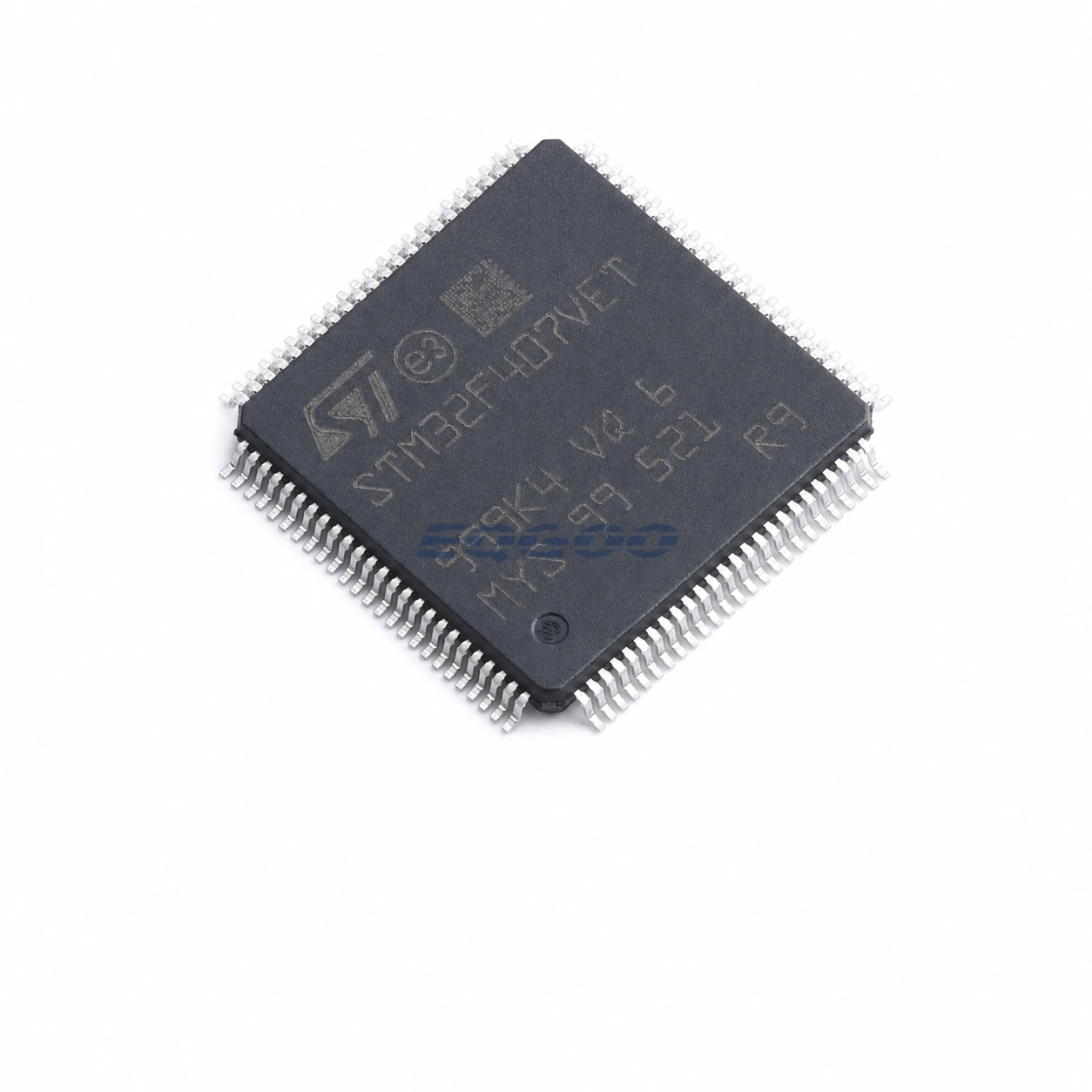
Key Selection Information
| Selection Parameter | Confirmed Information |
|---|---|
| Package | LQFP-100(14×14) |
| Supply voltage | 1.8V~3.6V |
| CPU Core | ARM Cortex-M4 |
| Maximum CPU speed | 168MHz |
| Program memory | 512KB |
| Operating Temperature | -40℃~+85℃ |
| Number of I/O | 82 |
F407 connectivity in a 100-pin footprint
STM32F407VET6 is a 168 MHz Cortex-M4 device with FPU/DSP, 512 KB of Flash and an industrial LQFP-100 package. ST lists 82 I/Os for the exact VET6 orderable.
Unlike the F405 branch, the F407 architecture adds a 10/100 Ethernet MAC with IEEE 1588 support and a parallel camera interface while retaining USB OTG, dual CAN, three ADCs, two DACs and the F4 timer/DMA architecture. That connectivity profile is the main engineering reason to choose an F407 rather than treating it as only another 168 MHz MCU.
Technical Specifications
| Parameter | Value |
|---|---|
| Package | LQFP-100(14×14) |
| Supply voltage | 1.8V~3.6V |
| CPU Core | ARM Cortex-M4 |
| Maximum CPU speed | 168MHz |
| Program memory | 512KB |
| Operating Temperature | -40℃~+85℃ |
| Number of I/O | 82 |
| DAC (Bit) | 12bit |
| ADC (Bit) | 12bit |
| Program Memory Type | FLASH |
| Core Size | 32 Bit |
| Oscillator Type | Built-in |
VET6 means 512 KB plus 100-pin I/O
The E memory code fixes 512 KB of Flash, and the V package provides an LQFP-100 footprint with 82 I/Os. This is a useful balance when Ethernet or camera connectivity is required but a 144-pin board footprint is unnecessary. If firmware needs 1 MB, the G memory variant is the more direct comparison.
Connectivity must be budgeted with pins
Ethernet, the camera interface, external-memory signals, USB, CAN and display-style parallel buses can consume a large fraction of the 100-pin package quickly. The family may support all of them, but a valid design depends on the exact alternate-function map and on which interfaces need to operate together.
Where the 100-pin F407 fits
VET6 is well suited to connected control or data-acquisition systems that need FPU/DSP processing plus Ethernet, USB or camera-facing capability while staying in LQFP-100. The 512 KB Flash limit should be checked against networking stacks, file systems and application code before the device is selected.
External-interface requirements
The Ethernet block is a MAC, so an external Ethernet PHY and magnetics/interface implementation are still required. True USB high-speed operation requires the HS controller’s external ULPI PHY path. If Ethernet, camera and external memory are combined, validate the pin map early; the 82-I/O package can become the limiting resource before CPU performance does.
For more program-memory headroom in the STM32F407 LQFP-100 family, compare STM32F407VGT6, which specifies 1 MB Flash versus this VET6 variant’s 512 KB. Both use 100-pin LQFP order codes, but verify the final pin assignment, flash layout and firmware build before migrating.
Related Engineering Resources
- STM32F407VET6 Datasheet (PDF) — HKEQGOO-hosted copy of the STMicroelectronics datasheet used for technical review.
- STMicroelectronics product page — official manufacturer product, lifecycle, ordering and documentation resource.
Quality & Verification Support
Third-party inspection or testing can be arranged according to customer requirements. Testing fees are borne by the buyer. Additional verification requirements can be discussed before shipment. After an order is placed, physical product, label, packaging, and Date Code photos may be provided where appropriate.
For 512 KB Flash in a 144-pin LQFP rather than this 100-pin package, compare STM32F407ZET6. Check the revised footprint and exposed peripheral pins before designing a board around the larger package.
When both 1 MB Flash and a 144-pin LQFP are required, review STM32F407ZGT6. It differs from this 512 KB, 100-pin device in memory size and PCB pinout, so firmware allocation and board routing require separate evaluation.
Request a Quote
To request a quotation, provide the manufacturer part number, required quantity, destination, target Date Code if applicable, and any testing or inspection requirements.